
Traffic between Austin and San Antonio can eat up to 2.5 hours during peak congestion. It is a frustrating reality for the roughly 80-mile stretch of I-35 that connects two of Texas’s fastest-growing cities.

Now, Elon Musk says he has a fix: an underground tunnel system that could cut that commute to 30 minutes. The claim, posted by Musk on X, has reignited conversation around The Boring Company — the tunneling startup he founded in 2016 — and its ambitions in the Lone Star State.
This isn’t the first time Musk has promised to revolutionize urban travel. So how realistic is this latest pitch, and what would it actually take to build?
In this article, The Innovators Jam breaks down the claim, the technology behind it, The Boring Company’s track record, and what to watch for next.
What Did Elon Musk Actually Say?
According to Musk’s post, The Boring Company is working on what he describes as a “precursor Hyperloop tunnel” connecting Austin and San Antonio, designed to move vehicles at speeds exceeding 200 mph. Musk claims the current 2.5-hour congested drive could be reduced to a fraction of that time using this system.

This isn’t a brand-new idea — Musk has floated an Austin–San Antonio tunnel link for years, and The Boring Company has previously been in talks with officials in both cities about potential projects, including a proposed tunnel near San Antonio International Airport.


What Is The Boring Company?
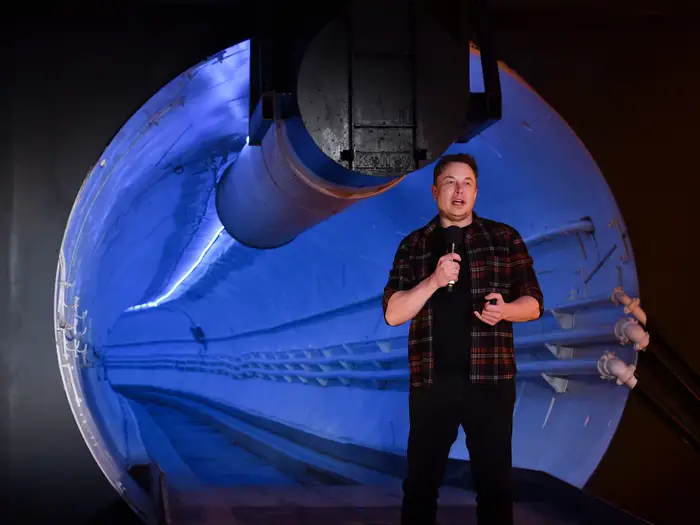
For readers unfamiliar with the company: The Boring Company (TBC) is a tunnel-construction and infrastructure startup founded by Elon Musk in 2016. It was born out of Musk’s frustration with Los Angeles traffic, with an original vision of high-speed pods ferrying passengers and cars through underground tunnel networks at airplane-like speeds.

That vision has since been scaled down considerably. TBC’s flagship project — the Las Vegas Convention Center Loop — uses standard Tesla vehicles (human-driven or autonomous) traveling through narrow tunnels between stations, rather than the futuristic high-speed pod system originally pitched. The Vegas Loop spans roughly 1.7 miles and cost approximately $47 million to build.
The Gap Between the Pitch and the Track Record
This is where skepticism comes in. Comparing Musk’s original 2016 vision to what’s actually been delivered reveals a pattern worth understanding before taking any new claim at face value:
| Promise | Reality |
|---|---|
| 2016: Pods moving at 700+ mph | Today: Teslas driven through tunnels at regular road speeds |
| Westwood to LAX in 5-6 minutes | Never built |
| Multiple city tunnel networks (LA, multiple Texas cities) | Only Vegas Loop operational at scale |
| High-speed Hyperloop demo (Austin-San Antonio floated since ~2021) | Still in early/precursor stages as of this claim |
None of this means the new Austin–San Antonio proposal is impossible — but it does mean the “30 minutes” figure should be read as an aspirational targe.
Why Tunnel Construction Is Harder Than It Sounds
A few real-world factors stand between a tweet and a functioning intercity tunnel:
- Cost at scale: The Vegas Loop cost about $47 million for under 2 miles. An 80-mile Austin–San Antonio tunnel would be a vastly larger undertaking, likely running into the billions.
- Permitting and regulation: Any tunnel project needs sign-off from state transportation, environmental, and infrastructure agencies — a process that has historically taken years for TBC’s other proposed projects.
- Speed vs. safety: Reaching the 200+ mph speeds Musk references requires engineering well beyond the current Vegas Loop model, which operates at standard road speeds.
- Financing structure: Past Boring Company proposals (like the San Antonio airport tunnel) have relied on revenue bonds repaid through fares — meaning the project’s viability depends on ridership projections panning out.
What Would Have to Happen for This to Become Reality
For the Austin–San Antonio “precursor Hyperloop” tunnel to move from claim to construction, several milestones would likely need to occur:
- A formal engineering and feasibility study
- Regulatory approval from Texas transportation authorities
- A confirmed financing structure and cost estimate
- A construction timeline with contracted milestones
- A working test segment demonstrating the promised speeds
Elon Musk’s claim that The Boring Company can shrink a 2.5-hour Texas drive to 30 minutes is an exciting vision — and given Musk’s history with Tesla and SpaceX, it would be a mistake to dismiss it outright. But it’s also consistent with a pattern of bold early promises from The Boring Company that have historically been scaled back significantly.
For now, the smartest approach is to treat this as an early-stage proposal worth watching, not a done deal.
Found this article interesting? Subscribe to The Innovators Jam for news, views, and write-ups on innovation, science, future-tech and research.
Follow us: Instagram @theinnovatorsjam, Youtube @InnovatorsJam, LinkedIn @ The Innovators Jam




We would love to hear from you. Leave your reply here.