
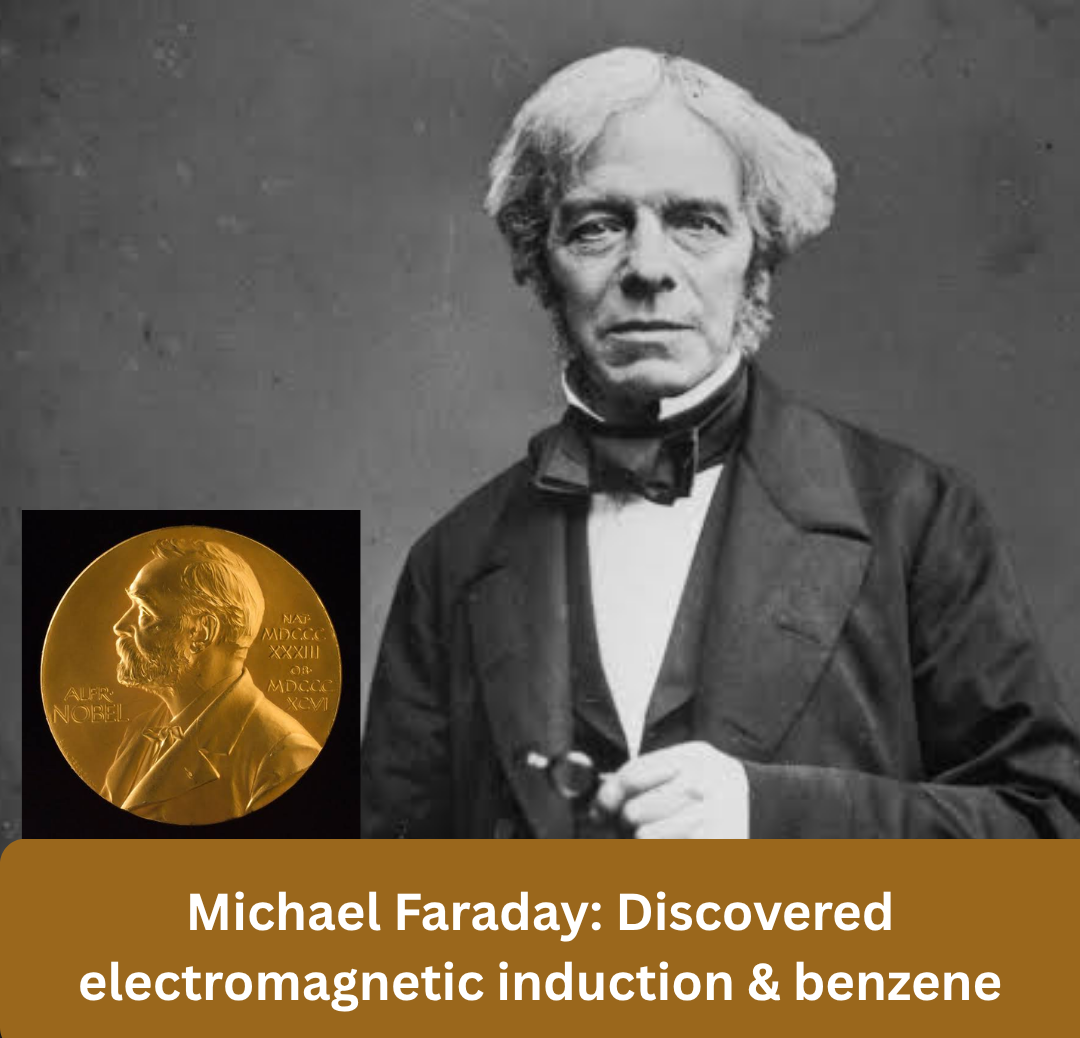
Michael Faraday (1791–1867) was an English scientist who discovered electromagnetic induction, the principle behind electric generators and transformers. Born into a poor family and largely self-taught, he became one of the most influential experimental scientists in history.
His work on electricity, magnetism and chemistry helped lay the foundation for modern power generation and for the later theory of electromagnetism.
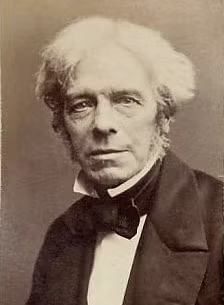
Born: September 22, 1791, Newington Butts, Surrey, England
Died: August 25, 1867, Hampton, Middlesex, England
Field: Physics, Chemistry
Known for: Electromagnetic induction, electromagnetic rotation, laws of electrolysis, discovery of Benzene
Nationality: British
Who was Michael Faraday?
Michael Faraday was an English chemist and physicist whose experiments established the foundations of electromagnetism and electrochemistry. He came from a poor family and had no schooling beyond the elementary level. His father was a blacksmith. He spent his career at the Royal Institution in London, where he was appointed Fullerian Professor of Chemistry in 1833.


How did a bookbinder’s apprentice become a scientist?
At 14, Faraday was apprenticed to a London bookbinder and used the job to read the science books that passed through the shop. In 1812 he was given tickets to Humphry Davy’s lectures at the Royal Institution. He wrote up his notes, added his own drawings of the apparatus, and sent them to Davy.
Davy took him on, and on March 1, 1813, Faraday was appointed laboratory assistant at the Royal Institution. He stayed there for the next 54 years.
Also Read: Ernest Rutherford: The father of nuclear physics
What did Michael Faraday discover?
- 1821, electromagnetic rotation: After Ørsted’s discovery of electromagnetism, Faraday built devices that produced continuous circular motion from magnetic force, an early step toward the electric motor.
- 1823, liquefied Chlorine: He showed that Chlorine could be turned into a liquid.
- 1825, Benzene: He discovered the substance now known as Benzene.
- 1831, electromagnetic induction: his most famous discovery, explained below.
- 1833, laws of electrolysis: These link the amount of chemical change at an electrode to the electric charge passed.
- 1845, the Faraday effect: he showed that a magnetic field can rotate the polarisation of light, an early sign that light and magnetism are connected.
How did Faraday discover electromagnetic induction?
Faraday discovered electromagnetic induction in August 1831, showing that a changing magnetic field can produce an electric current in a nearby wire. Scientists already knew that electric currents create magnetism. The open question was whether magnetism could create electricity.

Faraday wound two separate coils of wire around an iron ring. When he connected one coil to a battery, a galvanometer on the second coil showed a brief pulse of current, even though the coils were not physically connected. Within weeks, he had shown that moving a magnet near a wire, or a wire near a magnet, could also generate electricity. He presented his results to the Royal Society on November 24, 1831.
The key insight: the magnetic field must be changing, or the magnet and wire must be moving relative to each other, for a current to be induced.
What is electromagnetic induction used for today?
Electromagnetic induction is the working principle of electric generators and transformers, which are central to how electricity is produced and distributed. The discovery led to the development of generators and transformers. The same principle powers induction cooktops and wireless phone chargers.
Was Michael Faraday the inventor of the electric generator?
Partly. Faraday demonstrated the principle in 1831, including with a rotating copper disc that produced a steady current. But his early devices were laboratory demonstrations, and practical commercial generators were developed later by other engineers.
The American scientist Joseph Henry also observed induction around the same time. Faraday published first, and his systematic experiments made the discovery widely understood.
What is Michael Faraday’s legacy?

Faraday introduced the idea of fields of force. James Clerk Maxwell later turned that idea into the mathematical equations of electromagnetism. The unit of electrical capacitance, the farad, is named after him.
He was also a pioneer of science communication. In 1825 he began the Royal Institution’s Christmas Lectures for young audiences, a tradition that continues today.
FAQs
When was Michael Faraday born?
Michael Faraday was born on 22 September 1791 in Newington Butts, Surrey, England.
What is Michael Faraday best known for?
He is best known for discovering electromagnetic induction in 1831, the principle behind electric generators and transformers.
Did Michael Faraday go to university?
No. He learned science by reading books during his apprenticeship and trained on the job at the Royal Institution.
What unit is named after Michael Faraday?
The farad, the SI unit of electrical capacitance.
Found this article interesting? Subscribe to The Innovators Jam for news, views, and write-ups on innovation, science, future-tech and research.
Follow us: Instagram @theinnovatorsjam, Youtube @InnovatorsJam, LinkedIn @ The Innovators Jam



We would love to hear from you. Leave your reply here.