
A Canva event about the future of artificial intelligence in London was interrupted this week by an activist protesting against the rapid expansion of AI.

The incident took place on September 15, 2026, during Canva’s AI Vision London event at Magazine London. The event brought together technology companies, business leaders and creatives to discuss how artificial intelligence is changing work, creativity and business. Speakers included Canva co-founder Cameron Adams and UK Minister for AI Kanishka Narayan.
During the event, an activist associated with the UK grassroots group Pull The Plug interrupted the programme and raised concerns about the direction of AI development. The protester was subsequently removed from the venue.
The incident has since sparked discussion online about a much bigger question: should AI development continue at its current speed, or does society need stronger safeguards and more public involvement?


Who is Pull The Plug?
Pull The Plug is a relatively new UK grassroots campaign. The group says it was created by people concerned about the impact of AI on jobs, communities and the environment. Importantly, the organisation describes itself as not anti-technology or anti-AI.

Its main argument is about who should control the development and deployment of AI. The group wants the UK government to establish legally binding Citizens’ Assemblies on AI.
These would bring ordinary citizens together with experts to discuss how AI should be developed and used, with the group arguing that decisions should not be left primarily to technology companies and governments.
The organisation emerged in the UK at the end of 2025. Its founders include Harry Atkinson, a former film-industry story editor, and Frieda Lurken, who previously co-founded climate activist group Extinction Rebellion.
Pull The Plug has already worked with PauseAI, another AI-focused activist movement. In February 2026, the two groups helped organise a London protest involving hundreds of people around concerns about AI safety, corporate power, environmental impact and democratic oversight.


Why are they protesting AI?
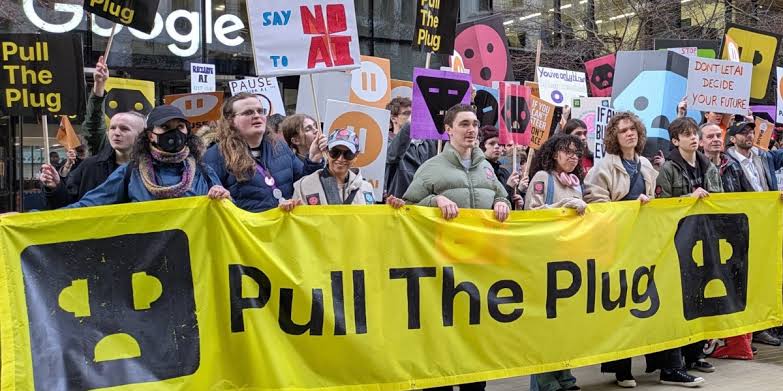
The concerns are broader than AI-generated images or job losses. Pull The Plug has raised questions about the rapid construction of AI data centres, which require large amounts of electricity and infrastructure.
Campaigners also point to concerns around surveillance, employment, creative industries, concentration of technological power and the possibility of advanced AI systems creating risks that governments may struggle to control.
These concerns are not all based on the same evidence, and they should not automatically be treated as established facts. For example, the environmental impact of AI depends heavily on how data centres are powered, how efficiently they operate and where they are located. Similarly, predictions about future AI systems causing catastrophic harm remain subjects of significant scientific and policy debate.
What does Canva say about AI?

Canva’s AI Vision programme takes a very different approach. The company presents AI as a tool that can help people work and create more effectively. Its London event focused on the practical future of AI, bringing together people from technology, business and creative industries.
That does not mean the debate is simply “Canva supports AI, protesters oppose it.” The real disagreement is about speed, control and accountability of AI, not Canva. Companies developing and deploying AI argue that the technology can increase productivity, expand access to creative tools and help people perform tasks that previously required specialist skills.
Critics argue that technological benefits should not come at the expense of workers, communities, privacy or environmental resources.
The critical question about AI development
This protest raises a legitimate question, but the method also matters. Interrupting an event can attract attention to an issue that might otherwise receive little coverage. At the same time, disruption can make it harder for protesters to engage directly with the people they want to influence.
There is also a wider challenge for the movement itself. AI is not one technology with one impact. It includes everything from accessibility tools and scientific applications to generative AI, surveillance systems and increasingly powerful computing infrastructure.
That means arguments for or against “AI” as a whole can quickly become too broad. This incident is ultimately part of a much larger conversation now taking place in the UK and elsewhere:
- Who should decide how fast AI develops?
- hat limits should apply
- How much say should ordinary people have in that future?
Found this article interesting? Subscribe to The Innovators Jam for news, views, and write-ups on innovation, science and research.
Follow us on Instagram @theinnovatorsjam, Youtube @InnovatorsJam, LinkedIn @ The Innovators Jam





We would love to hear from you. Leave your reply here.