
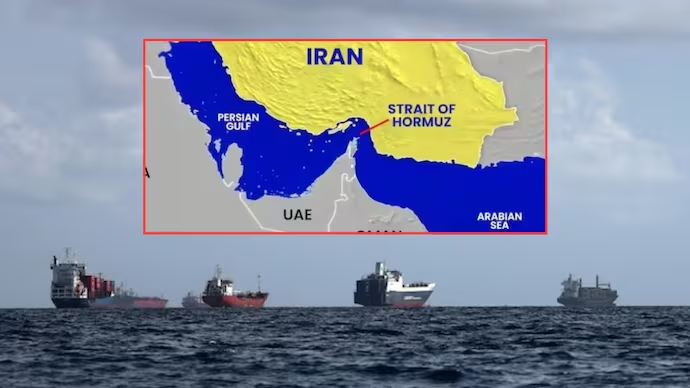
A prolonged disruption around the Strait of Hormuz has created an unexpected environmental risk related to the marine species. The ships that have remained stationary for weeks or months could carry marine organisms to new ecosystems when they resume their journeys, claims a new study.
An international team of marine scientists says the unusually long lay-up of more than 1,500 large commercial vessels in the Persian/Arabian Gulf and Gulf of Oman could create conditions for a major marine bioinvasion event. The warning comes from a study published in Biological Invasions, titled “Closure of the Strait of Hormuz may trigger a bioinvasion super-spreader event.”
Also Read About: NASA Roman Space Telescope: Launch date, mission, dark energy, dark matter & exoplanets
Why are ships becoming an environmental concern?
The problem begins with something called biofouling. When ships move through the world’s oceans, marine organisms can attach themselves to their submerged surfaces. These include algae, barnacles, mussels, microorganisms and other marine invertebrates.
Under normal shipping conditions, vessels spend relatively little time stationary. But when ships remain at anchor or in lay-up for extended periods, organisms have more time to attach, grow and reproduce.
The scientists warn that the prolonged disruption around Hormuz has created an unusual opportunity for this biological growth.
Instead of simply being vessels waiting to sail, some ships could effectively become floating marine habitats. And when they eventually leave the region, the organisms attached to their hulls could travel with them.
What is the Strait of Hormuz bioinvasion risk?

The Strait of Hormuz is one of the world’s most strategically important maritime chokepoints, connecting the Persian Gulf with the Gulf of Oman and the Arabian Sea.
A large disruption to shipping in this region therefore has consequences far beyond oil and global trade. According to the study, more than 1,500 large commercial ships were left stationary in the Persian/Arabian Gulf and Gulf of Oman following the disruption that began on February 28, 2026.
For marine scientists, the concern is what happens underneath those ships. The longer a vessel remains stationary, the more opportunity marine organisms have to colonise its submerged surfaces.
How can ship biofouling spread invasive species?
The process can be understood in four stages:
1. Organisms attach to the ship – Algae, barnacles, mussels and other organisms settle on submerged surfaces.
2. The organisms grow – Extended periods of inactivity give these organisms more time to establish dense communities.
3. The ship resumes its voyage – When the vessel eventually leaves the Gulf, the attached organisms travel with it.
4. Organisms reach another ecosystem – Some organisms or their larvae can potentially detach or be released at another port.

If they survive and reproduce in the new environment, they could become non-native or invasive species. This is already a recognized pathway for marine species introductions around the world.
What organisms could be transported?
Biofouling communities can contain a wide range of organisms. These may include:
- Barnacles
- Mussels and other molluscs
- Algae
- Crustaceans
- Other marine invertebrates
- Microorganisms
- Parasites and potentially pathogens
One species discussed in the study is the barnacle Amphibalanus improvisus. According to research cited by the scientists, an adult can release up to 36 larvae per day at 30°C.

The researchers therefore warn that heavily fouled vessels could potentially release very large numbers of larvae during and after their prolonged stay in the Gulf. That does not mean every larva will survive, establish or become invasive.
The risk depends on multiple factors, including environmental conditions, the species involved and whether the organisms can reproduce successfully in their new location.
Why the Persian Gulf matters
The Persian/Arabian Gulf is a particularly unusual marine environment. Its waters are characterized by high temperatures and high salinity, creating challenging conditions for marine life. Species capable of surviving these conditions may have characteristics that help them tolerate environmental stress.
This becomes important when considering potential destinations. A non-native organism is more likely to establish itself if the new environment provides suitable conditions for survival and reproduction.
That is one reason scientists are particularly interested in ports connected to the Gulf through regular shipping routes.
This is not the first time ships have moved invasive species
Ships have been transporting marine organisms between ecosystems for centuries. Modern shipping has dramatically increased the scale and speed of that movement. Biofouling is now recognized internationally as one of the pathways through which marine invasive species can spread.
The unusual factor in the current Strait of Hormuz situation is the scale of the ship lay-up and the length of time vessels have remained stationary.
The researchers describe the situation as potentially creating a “super-spreader” event because an unusually large number of vessels may have accumulated significant biological growth at the same time.
What happens when these ships start moving again?
This is the critical question. A vessel that has remained stationary for months may not have the same biofouling profile as it had when it arrived. Before resuming international voyages, ships could therefore require inspection, cleaning and other biosecurity measures.
The scientists recommend identifying vessels with significant biofouling and cleaning them before they travel to other ecosystems. Where cleaning cannot happen before departure, ports receiving these vessels could increase monitoring.
Potential tools include physical sampling, settlement plates and molecular techniques capable of detecting organisms through environmental DNA.
The Innovators Jam‘s take
A prolonged shipping disruption has potentially transformed thousands of commercial vessels into temporary floating ecosystems. Now scientists want ports and shipping operators to make sure those ecosystems don’t hitchhike to their next destination. For India, the message is simple: Mumbai and other Gulf-linked ports may need to watch what arrives on the hull, not just what is inside the cargo hold.
Subscribe to The Innovators Jam for the latest insights, news, analysis, and features on science, research, and innovation.
Instagram: TheInnovatorsJam Youtube: InnovatorsJam LinkedIn: The Innovators Jam






We would love to hear from you. Leave your reply here.