
Astronomers say they’ve found the first genuinely green star. Before you picture a glowing emerald in the night sky, there’s a catch.
For years, “there’s no such thing as a green star” has been one of astronomy’s facts. Stars come in red, orange, yellow, white and blue. Never green. Then, in October 2026, a team at the University of Warwick announced that a white dwarf called WD J1330+6435 might break the rule.

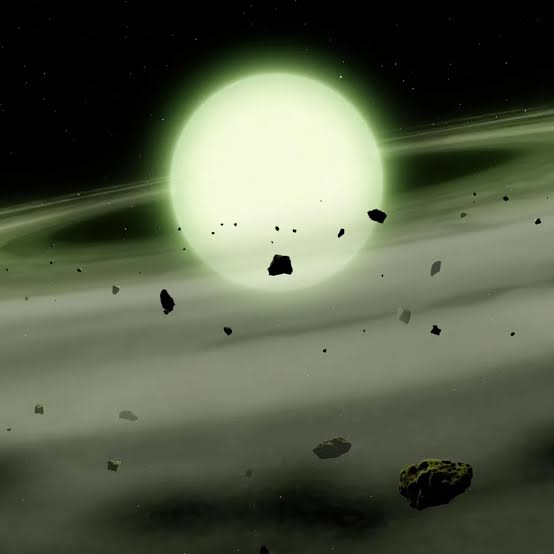
Artistic impression of the green star WD J1330+6435
First, why aren’t stars green?
Here’s the surprise: many stars, our Sun included, put out their strongest light in the green part of the spectrum. But they also pour out every other colour at the same time. Your eyes and brain blend the whole mix and call it white or yellowish. Star colour is mostly a thermometer reading:
- Cool stars look red or orange.
- Middling stars look yellow-white.
- Hot stars look blue-white.
So what’s different about this one?
WD J1330+6435 is a white dwarf: the dense, cooling leftover of a star that has run out of fuel. At about 4,000°C, it’s cool for a white dwarf. By temperature alone it should glow orange-ish. But this star has a secret. It has swallowed rocky debris from its own planetary system, and that material has enriched its atmosphere with calcium, lithium and sodium.
Normally, a sprinkle of metals in a star’s atmosphere would leave only thin, narrow dark lines in its spectrum. Here, though, the atmosphere is crushingly dense, about 1 gram per cubic centimetre, roughly the density of water. At that density, the sodium gets squeezed by the surrounding helium plasma and absorbs a wide swathe of light instead of a thin sliver.
In the words of the researchers, the sodium soaks up the orange part of the spectrum. Take orange out of an orange-ish glow and what’s left leans green.
Okay, but would it really look green?
Here’s the fine print.
1. Nobody has actually seen it as green. No white dwarfs are close enough to look at directly. The team took each star’s spectrum, the fingerprint of its light, and ran it through a computer model of human colour vision to work out what our eyes would perceive. The green is a prediction, not a photograph.
2. It’s a ghostly green, not neon. The researchers’ own phrase was a “ghostly green glow.”
The team found that white dwarfs fall into colour groups depending on what’s in their atmospheres:
| Colour | What’s behind it |
|---|---|
| Green | Sodium (plus calcium and lithium) from swallowed rocky planetary debris absorbing orange light. Example: WD J1330+6435 |
| Pink / purple | Carbon-rich atmospheres. Carbon molecules distort the light |
| Salmon-pink (reddest known) | Carbon dredged up from deep inside by a convection zone. Example: WD J1011+2845, 48 light-years away |
| Yellow | Debris from swallowed asteroids and comets |
| Cyan / pale blue | Cooler white dwarfs with mixed hydrogen and helium atmospheres |
| White | The default. Pure temperature-based glow |
The common thread is that density changes the rules. Squeeze an atmosphere hard enough and trace elements stop behaving like they do in a thin gas. They start repainting the star.
Don’t expect a rainbow sky
The team looked at 151 white dwarfs within about 65 light-years. Only five looked unusual: two yellow and three pink. That works out to roughly one in 30 being oddly coloured.
The other 146 glow a warm, light-bulb white. That also corrects a common idea that white dwarfs are typically blue. As Professor Boris Gänsicke put it, the average white dwarf really is white.
Found this article interesting? Subscribe to The Innovators Jam for articles, news, views, and write-ups on innovation, science and research.
Follow us on Instagram @theinnovatorsjam, Youtube @InnovatorsJam, LinkedIn @ The Innovators Jam




We would love to hear from you. Leave your reply here.