
On June 24, 2026, Venezuela experienced something both terrifying and scientifically rare. Two powerful earthquakes struck within 40 seconds of each other, a magnitude 7.2 foreshock, immediately followed by a 7.5 mainshock, the largest recorded earthquake in Venezuela’s history and the strongest in over 125 years.

Buildings collapsed across Caracas. A waterfront hotel in La Guaira was reduced to rubble. Simón Bolívar International Airport was shut down.
The USGS estimated a 44% probability of deaths between 10,000 and 100,000, with economic losses potentially reaching 20% of Venezuela’s GDP.
A fault line that has been building for centuries:
Venezuela sits at one of the most geologically complex boundaries in the Americas — the Boconó-Morón-El Pilar Fault System. Here, the Caribbean Plate and the South American Plate collide in what scientists describe as a right-lateral strike-slip boundary. This fault system stretches over 1,300 kilometres along Venezuela’s northern coast, from the central Andes to Trinidad.
The Boconó Fault triggered devastating earthquakes in 1610 and 1894. Caracas has vivid memory of what a major seismic event looks like. On July 29, 1967, a magnitude 6.6 earthquake killed between 225 and 300 people and injured over 1,500, collapsing four major apartment buildings in the Altamira and Los Palos Grandes neighbourhoods — the very same districts worst hit by yesterday’s quakes. What the 1967 earthquake also revealed was something scientifically significant: Caracas is built on a deep alluvial basin that amplifies seismic waves, making it disproportionately vulnerable even to earthquakes whose epicentres lie far away.
That geological reality has not changed. What has changed — or more precisely, what has failed to change — is Venezuela’s seismic preparedness infrastructure.
Also Read: Why we still can’t predict the next big quake
What is a foreshock
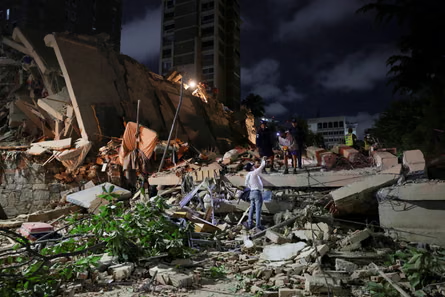
A foreshock is technically a smaller earthquake that precedes a larger mainshock on the same fault zone. The critical, frustrating truth is this: you can only call it a foreshock after the mainshock has happened.
In real time, a magnitude 7.2 earthquake is not a warning. It is itself a catastrophe. Emergency responders would have been scrambling to manage that event when the 7.5 struck 40 seconds later.
Seismologists have spent decades studying foreshock sequences. A major 2025 paper in Geophysical Research Letters examined foreshock migration patterns preceding the Mw 8.8 Kamchatka earthquake — arguably the biggest seismic event of 2025 — and found that foreshocks migrated directionally toward the mainshock hypocenter in multiple stages. This was visible only in hindsight, through detailed retrospective analysis.
Estimating how widespread foreshock activity is remains an open debate in the field. Studies have produced estimates ranging from 10% to 70% of large earthquakes being preceded by identifiable foreshocks — a range so wide it reflects how much remains unknown.
The innovations trying to close the gap
The inability to predict earthquakes has become one of the most energising problems in applied science. Some of the world’s leading research teams are throwing the most powerful tools available at it.
AI and Machine Learning: Promising but Not There Yet
In 2023, researchers from the Jackson School of Geosciences at the University of Texas at Austin developed an AI system. They trained on five years of Chinese seismic data capable of predicting 70% of earthquakes up to a week in advance.
Researchers testing AI-based forecasting algorithms at scale found that, as of an August 2025 review in Physics Today, machine learning models are not yet outperforming traditional seismic forecasting methods.
Still, AI is genuinely transforming adjacent problems. Scientists at Kyoto University published research in Nature Communications in November 2025 showing that machine learning models trained on foreshock data could accurately detect subtle precursory signals. The lab does not yet translate to the field, but it marks a meaningful step in understanding fault mechanics.
Found this article helpful? Subscribe to The Innovators Jam for articles, news, views, and write-ups on innovation.
Follow us on Instagram @theinnovatorsjam, Youtube @InnovatorsJam, LinkedIn @ The Innovators Jam






We would love to hear from you. Leave your reply here.