
On June 15, 2026, Indian AI startup Sarvam AI entered the unicorn club after raising $234 million in a funding round led by HCLTech, valuing the company at $1.5 billion. But unlike many startup funding stories, the real headline isn’t the valuation. It’s what Sarvam built to earn it.
When India celebrated Skyroot Aerospace becoming a unicorn, the achievement was about private rockets, engines, and launch systems. Sarvam’s achievement is less visible but potentially just as transformative. The company is attempting to build India’s sovereign artificial intelligence (AI) stack designed for India’s languages, institutions, and digital future.
What has Sarvam built: A closer perspective
For two decades, India’s digital transformation has been built on foundational infrastructure. First came building identity through UIDAI and Aadhaar. Then came payments through National Payments Corporation of India and UPI. Now, the next layer may be AI infrastructure.
One reason Sarvam stands out is the background of its founders. Vivek Raghavan and Pratyush Kumar previously worked on large-scale Indian language and AI research initiatives, helping create datasets, translation systems, and speech technologies for Indian languages.
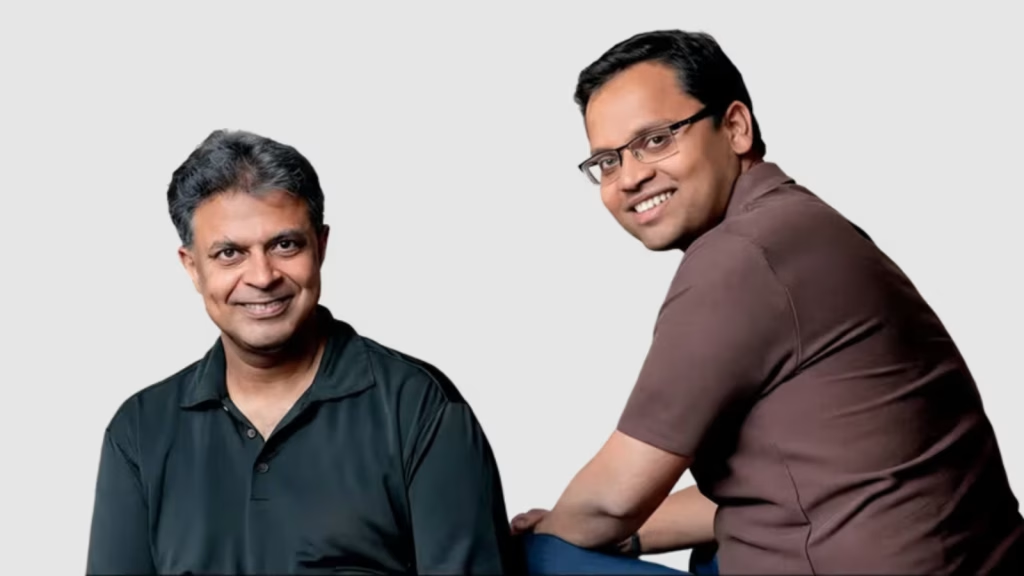
Their vision is ambitious: India should not merely consume AI built elsewhere. It should build its own. That message has become increasingly relevant as countries worldwide worry about dependence on foreign AI systems.
The real product isn’t a chatbot
Many people may assume that Sarvam is simply India’s version of ChatGPT. It isn’t. Sarvam describes itself as a full-stack sovereign AI platform offering speech recognition, translation, conversational agents, and foundational models across 22 Indian languages.
Its biggest innovation challenge wasn’t creating another chatbot. It was solving a uniquely Indian problem: How do you build AI for a country with hundreds of languages, accents, dialects, and code-mixed conversations?
Global AI models are primarily trained on English and a handful of major world languages. India requires something different.
Also read: Innovations that made Skyroot India’s first space-tech unicorn
The technology that created Sarvam AI
In February 2026, Sarvam launched two foundational models:
- Sarvam 30B
- Sarvam 105B
The flagship Sarvam 105B model contains 105 billion parameters and was trained from scratch with a strong focus on Indian language capabilities and enterprise applications.
What makes this significant is that very few countries have companies building frontier-scale AI models from the ground up. Most startups build applications on top of models from:
- OpenAI
- Google DeepMind
- Anthropic
Sarvam chose the harder route to build the foundation itself.
A DeepSeek moment for India?
One of the most remarkable facts about Sarvam is its scale. According to company leaders, many of its foundational models were developed by a research team of roughly 40 researchers. Industry observers compared this approach to China’s DeepSeek, which showed that efficient AI development can compete with larger, better-funded rivals.
For India’s startup ecosystem, this may be the most important lesson. The future of Indian innovation may not depend on having the most money. It may depend on building smarter, more focused research teams capable of solving local problems.
Sarvam & India’s AI independence moment
Sarvam’s rise comes at a time when governments worldwide are discussing “AI sovereignty”. The ability to control critical AI infrastructure rather than relying entirely on foreign providers.
Recent debates around access restrictions, AI regulation, and geopolitical technology competition have highlighted the risks of dependence on external models. Sarvam’s founders have repeatedly argued that India must develop its own frontier AI capabilities if it wants a meaningful role in shaping the future of technology.
This is why Sarvam’s unicorn status matters. It is not simply another startup crossing the billion-dollar mark.
It represents India’s first large-scale attempt to build an AI foundation layer comparable to how Aadhaar became the foundation for identity and UPI became the foundation for digital payments. Sarvam is trying to prove India can build artificial intelligence at the frontier.
______________________________________________________________________________
Found this article interesting? Subscribe to The Innovators Jam for articles, news, views, and write-ups on innovation, science and research.
Follow us on Instagram @theinnovatorsjam, Youtube @InnovatorsJam, LinkedIn @ The Innovators Jam



We would love to hear from you. Leave your reply here.