

As Central Africa battles a fresh outbreak of Ebola, scientists and health agencies are racing against time to develop vaccines for a dangerous strain that currently has no approved protection. The recent outbreak linked to the Bundibugyo strain of Ebola has triggered emergency responses across the Democratic Republic of the Congo and Uganda, with the World Health Organization declaring it a global public health emergency.
What makes this outbreak alarming is that existing Ebola vaccines were designed for the Zaire strain, not the Bundibugyo variant. Researchers are now developing new vaccine, while African governments are intensifying border checks, surveillance, isolation measures, and emergency preparedness efforts to prevent wider transmission.
It is also a cautionary reminder: even after COVID-19 transformed vaccine science, humanity still remains vulnerable to several deadly diseases for which no fully effective or universally available vaccines exist.
Ebola: Science vs a rapidly evolving threat
Ebola first emerged in 1976 and remains one of the world’s deadliest viral diseases. The virus spreads through direct contact with infected bodily fluids and can cause severe bleeding, organ failure, and death.
While vaccines such as Ervebo exist for some Ebola strains, the current Bundibugyo outbreak has exposed a major scientific gap. WHO officials have warned that vaccines tailored for this strain could still take months before deployment.
Africa’s response, however, has been swift. But outbreaks like these show how dangerous it can be when the world prepares only for known variants while new ones emerge unexpectedly. The Innovators Jam compiles a list of diseases for which no cure exists till now:
Hantavirus: The silent killer few talk about
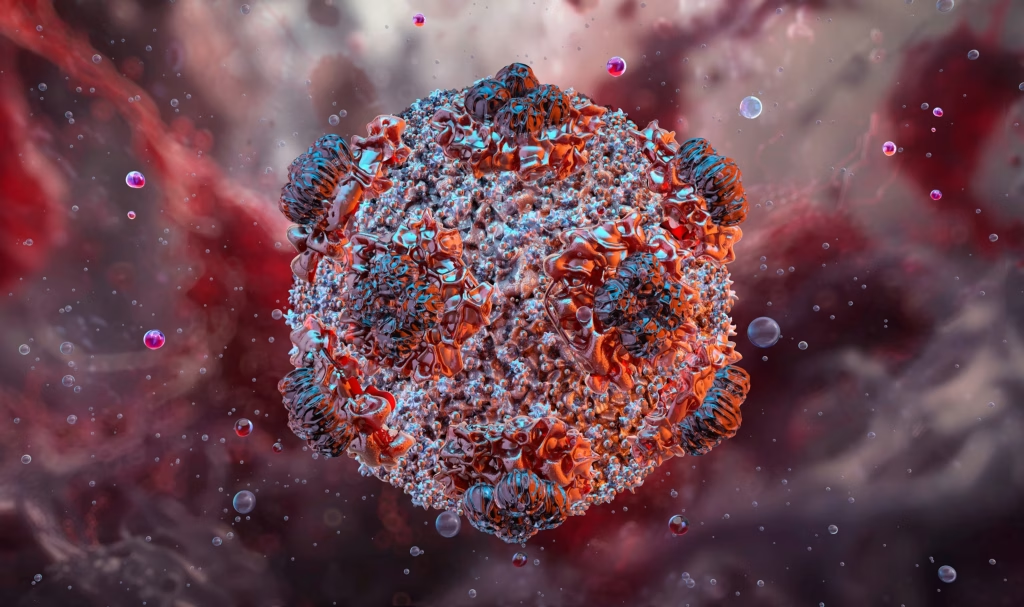
Another virus worrying scientists is the one causing Hantavirus. Unlike Ebola, Hantavirus spreads mainly through exposure to infected rodent droppings, urine, or saliva. In severe cases, it attacks the lungs and can become fatal.
Despite decades of research, there is still no widely approved global vaccine for Hantavirus. Prevention relies largely on sanitation, rodent control, and awareness. Its rarity often keeps it out of headlines — until sudden outbreaks occur.
HIV/AIDS:

Human Immunodeficiency Virus (HIV) Infection and Acquired Immunodeficiency Syndrome remains one of the biggest scientific challenges in medicine.
The virus mutates rapidly and directly attacks the immune system, making vaccine development extremely difficult.
Nipah Virus:

Nipah Virus Infection, carried by fruit bats, has caused deadly outbreaks in South Asia with mortality rates reaching alarming levels.
Marburg Virus:

Closely related to Ebola, Marburg Virus Disease can trigger severe internal bleeding and organ failure. No licensed vaccine is yet available for mass use.
Lassa Fever:

Lassa Fever infects hundreds of thousands annually in West Africa, but vaccine candidates are still under development.
Why there is no cure for some diseases
Scientists face several major obstacles:
- Rapid viral mutation
- Multiple strains and variants
- Rare outbreaks limiting clinical trials
- Weak healthcare infrastructure in affected regions
- Limited research funding
- Complex immune system interactions
In many cases, outbreaks occur in regions already facing conflict, displacement, or poor medical access — making containment even harder.
The future of vaccine & cure:
Technologies such as mRNA platforms, AI-assisted drug discovery, and next-generation immunology are accelerating vaccine development faster than before.
But science alone is not enough. Prepared healthcare systems, international cooperation, and early surveillance will determine whether future outbreaks stay localized or become global crises.
For young innovators, researchers, and science enthusiasts, this is one of the defining scientific battles of our time.
_____________________________________________________________________________
Found this update helpful? Subscribe to The Innovators Jam for more such articles.
Follow us on Instagram @theinnovatorsjam, Youtube @InnovatorsJam




We would love to hear from you. Leave your reply here.