
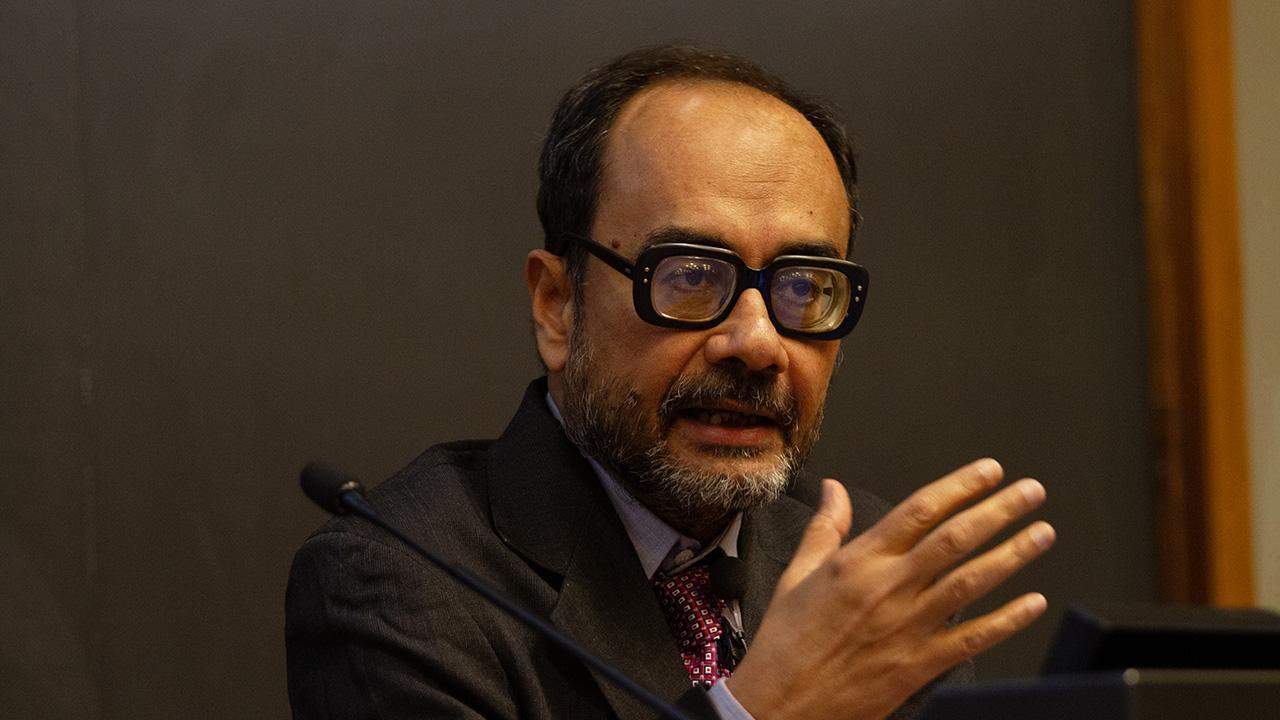
Ashoke Sen is one of India’s most internationally recognised theoretical physicists. His work on string theory, S-duality, black-hole entropy and string field theory has helped shape modern ideas about the fundamental laws of physics.
In October 2026, Sen became the first Indian physicist to receive the prestigious Oskar Klein Medal, awarded by Stockholm University and the Nobel Committee for Physics of the Royal Swedish Academy of Sciences for distinguished contributions to physics. But what makes Sen’s work remarkable is not just the list of awards. It is the questions he has spent his career trying to answer:
What are the most fundamental building blocks of the universe? How can quantum physics and gravity fit together? And what is really happening inside a black hole?

Born: 1956 in Kolkata, India
Education: Presidency College, Kolkata, and Indian Institute of Technology Kanpur. He later completed his PhD in physics at Stony Brook University in 1982.
After his doctorate, Sen worked at Fermilab and the Stanford Linear Accelerator Center (SLAC) before returning to India in 1988. He joined the Tata Institute of Fundamental Research (TIFR) in Mumbai and worked at the Harish-Chandra Research Institute in Allahabad. Now, Sen is an ICTS-Infosys Madhava Chair Professor at the International Centre for Theoretical Sciences (ICTS-TIFR) in Bengaluru.
What does Ashoke Sen study?

Sen works in theoretical physics, particularly in quantum mechanics, gravity and the fundamental structure of matter. One of the major frameworks he has worked on is string theory.
It proposes that the fundamental objects may be incredibly tiny one-dimensional strings. Different ways in which these strings vibrate can correspond to different particles.
S-duality: When strong becomes weak
One of Ashoke Sen’s most influential contributions is his work on S-duality. In physics, a theory can become extremely difficult to calculate when interactions become very strong.
Sen’s research helped establish important connections between strongly coupled and weakly coupled descriptions of physical systems. This is powerful because a problem that is difficult to solve in one regime may become much easier when viewed through its dual description.
His work on strong-weak duality became an important part of the development of modern string theory. It contributed to the growing realisation that apparently different string theories could be connected through deeper relationships.
In 2012, Sen received the Breakthrough Prize in Fundamental Physics for contributions to establishing the unifying structure of string theory.


How did Ashoke Sen help scientists understand black holes?
Black holes have enormous gravity, and their event horizons hide everything that crosses them from outside observers. But black holes also have entropy.
That creates a fundamental physics question:
If a black hole has entropy, what microscopic states are responsible for it?

Sen made major contributions to this problem through string theory. His work on black-hole microstates and entropy helped physicists connect the macroscopic entropy of certain black holes with the microscopic quantum states predicted by string theory.
This is sometimes described as the precision counting of black-hole entropy — determining how many microscopic configurations can account for the entropy associated with a black hole.
What is string field theory?
Another major part of Sen’s research is string field theory. Conventional quantum field theory describes particles and their interactions using fields.
String field theory attempts to develop a similar framework for the dynamics of strings. Sen’s research into unstable D-branes and tachyon condensation produced important insights into string field theory and the behaviour of unstable configurations in string theory.
These contributions became an important part of modern research into the mathematical and physical structure of string theory.
Ashoke Sen and the Oskar Klein Medal
In 2026, Sen added another major international honour to his career. The Oskar Klein Medal was established in 1988 and is named after Swedish theoretical physicist Oskar Klein.

It is awarded annually by Stockholm University and the Nobel Committee for Physics of the Royal Swedish Academy of Sciences to recognise distinguished contributions to physics. Sen became the first Indian physicist to receive the medal.
He also delivered the 2026 Oskar Klein Memorial Lecture at Stockholm University’s AlbaNova Centre on 22 October 2026. The lecture explored how string theory can lead to a consistent quantum theory of gravity and how it can help address outstanding questions about quantum black holes.
A scientist recognised around the world
The Oskar Klein Medal is only the latest in a long list of honours. His awards timeline runs as:
1989 — ICTP Prize
Sen received the ICTP Prize for his contributions to theoretical physics.
1994 — Shanti Swarup Bhatnagar Prize
He received India’s Shanti Swarup Bhatnagar Prize for his contributions to physical sciences.
1998 — Fellow of the Royal Society
At the age of 42, Sen was elected a Fellow of the Royal Society (FRS), one of the world’s oldest scientific academies.
The Royal Society recognises his work in quantum field theory, superstring theory, string field theory and the quantum properties of black holes.
2001 — Padma Shri
India honoured Sen with the Padma Shri for his contributions to science.
2009 — Infosys Prize
He received the Infosys Prize in Mathematical Sciences for his contributions to string theory and related areas of theoretical physics.
2012 — Breakthrough Prize in Fundamental Physics
Sen received the inaugural Breakthrough Prize in Fundamental Physics for his work on the unifying structure of string theory.
2013 — Padma Bhushan
He was awarded the Padma Bhushan, one of India’s highest civilian honours.
2014 — Dirac Medal
Sen received the Dirac Medal from the International Centre for Theoretical Physics, jointly with Andrew Strominger and Gabriele Veneziano, for important contributions to string theory.
2026 — Oskar Klein Medal
Sen became the first Indian physicist to receive the Oskar Klein Medal.
Why Ashoke Sen’s work matters
Ashoke Sen’s work is about questions that sit at the very edge of what physics can explain.
What is matter ultimately made of?
Can gravity and quantum mechanics be described within a common framework?
What microscopic states give a black hole its entropy?
String theory remains a theoretical framework rather than an experimentally confirmed final theory of nature. But Sen’s work has provided important mathematical and physical insights into these fundamental questions.
His career also illustrates something important about scientific innovation: sometimes innovation does not mean inventing a physical object.
It can mean finding a new connection between ideas.
Sen’s work has repeatedly done that — connecting strong and weak interactions, different descriptions of string theory, and the physics of black holes with microscopic quantum states.
Found this article interesting? Subscribe to The Innovators Jam for news, views, and write-ups on innovation, science, future-tech and research.
Follow us: Instagram @theinnovatorsjam, Youtube @InnovatorsJam, LinkedIn @ The Innovators Jam





We would love to hear from you. Leave your reply here.