
NASA’s Perseverance rover reached 45.22 kilometres on October 11, 2026, surpassing the previous record of 45.16 kilometres held by NASA’s Opportunity rover. NASA’s Jet Propulsion Laboratory announced this milestone on October 12.
The difference may look small, but the time taken to achieve it is striking. Perseverance covered the distance in about five and a half years. Opportunity took nearly 15 years to reach its previous record while exploring Mars from 2004 to 2018.

Pic Credit: NASA
The achievement is not just about distance. It also demonstrates how advances in autonomous navigation are helping planetary rovers travel across difficult terrain and reach more scientifically interesting locations. Read NASA’s official announcement.
How does NASA’s Perseverance rover drive itself on Mars?
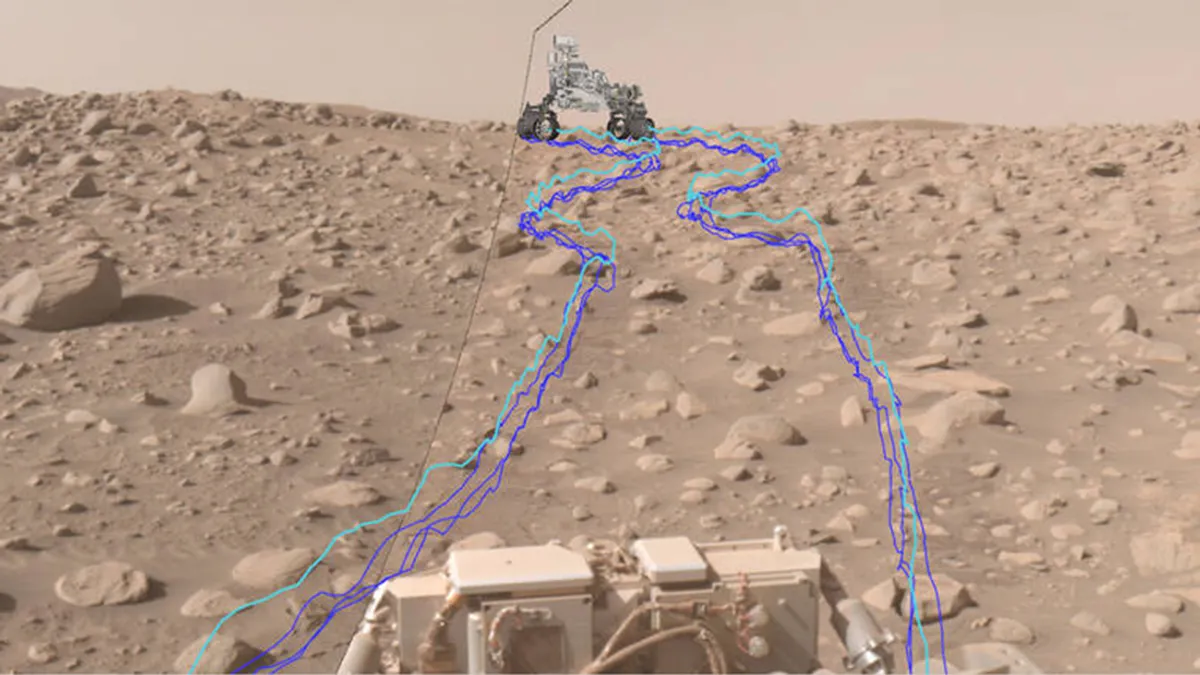
Perseverance uses an autonomous navigation system called AutoNav to assess the terrain and navigate around hazards. The rover captures images of the ground, builds a three-dimensional map of obstacles and identifies a safe route between waypoints selected by mission planners on Earth. It can then navigate sections of that route without engineers having to direct every movement.
According to NASA, more than 90% of Perseverance’s total driving distance has used AutoNav to evaluate the terrain. By comparison, the earlier autonomous navigation system on Opportunity and its twin, Spirit, was used for about 5% of their total driving distance.

The difference in computing capability is equally striking. NASA’s first Mars rover, Sojourner, assessed 20 measurement points along its path. Perseverance processes around 600,000.
(Pic credit: NASA)
This allows the rover to identify potential obstacles and make driving decisions with far more information than earlier Mars missions could use.
As Mark Maimone, deputy team chief for Perseverance’s robotic operations, explained in NASA’s announcement: “The rover that broke this record did so by making its own decisions about the path.”
However, Perseverance is not operating entirely without human oversight. Mission planners still select destinations and waypoints, while the onboard system helps the rover navigate safely between them.
Has NASA used generative AI to drive Perseverance?
Yes. In January 2026, NASA reported that Perseverance had completed the first drives on another world planned using generative AI. For those demonstrations, carried out on December 8 and 10, 2025, a vision-language AI model analysed terrain data and generated waypoints that would normally be selected by human rover planners.
The rover travelled 210 metres on the first drive and 246 metres on the second. Before commands were sent to Mars, NASA engineers tested them using a digital replica of the rover and verified more than 500,000 telemetry variables.
The work was led by NASA’s Jet Propulsion Laboratory in collaboration with Anthropic, using its Claude AI models. This was a separate demonstration from Perseverance’s record-breaking drive. It showed how generative AI could help plan routes, while AutoNav continues to handle onboard terrain assessment and navigation.
Why does this matter? Mars is, on average, about 225 million kilometres from Earth. Signals take long enough to travel between the planets that real-time remote driving is impossible. Greater autonomy can help missions cover more ground without requiring humans to plan every movement manually.
What is Perseverance searching for on Mars?
Perseverance landed on Mars on February 18, 2021, and has been exploring Jezero Crater, an area that once contained a lake and a river delta. Its mission is to study Mars’ geology and climate, search for evidence of ancient microbial life and collect rock and regolith samples for possible return to Earth.
As of the October 2026 driving milestone, the rover had collected 29 rock and regolith samples from the crater floor, the ancient river delta and the crater rim.
One of its most intriguing findings came from a rock nicknamed “Cheyava Falls”. In 2025, research published in Nature reported potential biosignatures in a sample collected from this rock. These findings may point to past biological activity, but they do not confirm that life existed on Mars.
On Earth, hydrothermal environments can support microbial life. Studying similar ancient environments on Mars could help scientists understand whether the planet once had conditions suitable for life.
What happens next for NASA’s Perseverance rover?
NASA has approved an extension of Perseverance’s mission, allowing it to continue exploring the crater rim through roughly the end of 2028. After investigating Lac de Charmes, the rover is expected to continue along the rim and head south towards Rainbow Falls, a region containing ancient crust uplifted by the impact that formed Jezero Crater.
NASA says the rover’s mobility systems remain fully operational, and favourable tests suggest it could continue adding to its driving record for years.
The distance milestone is therefore more than a record for a robotic vehicle. Longer drives can give scientists access to a wider range of rocks, geological formations and possible records of Mars’ ancient environments.
For Perseverance, every kilometre is an opportunity to learn something new about the Red Planet.
The Innovators Jam‘s Take
Perseverance’s record shows how robotics and autonomous navigation are changing planetary exploration. Instead of depending on instructions for every movement, the rover can evaluate terrain and navigate around hazards while scientists on Earth focus on where the mission should go next.
If robots can increasingly navigate other planets on their own, how much more could we discover about worlds humans have never visited?
Found this article interesting? Subscribe to The Innovators Jam for news, views, and write-ups on innovation, science, future-tech and research.
Follow us: Instagram @theinnovatorsjam, Youtube @InnovatorsJam, LinkedIn @ The Innovators Jam



We would love to hear from you. Leave your reply here.