
Science loves a clean origin story: one genius, one eureka moment, one name in the textbook. Real discoveries are messier and history has a habit of handing the credit to whoever was standing in the right spot at the right time. The Innovators Jam brings you stories of five scientists whose breakthroughs reshaped their fields, but their names got left off the mentions and celebrations:
1. Rosalind Franklin – The scientist behind Photo 51

Franklin’s X-ray diffraction work produced Photo 51. It is the historic image that revealed DNA’s double-helix structure.
James Watson saw it without her permission, and it became the missing piece that let Watson and Crick build their DNA helix model. In 1962, Watson, Crick, and Maurice Wilkins won the Nobel Prize for the discovery, while Franklin, who had died four years earlier of ovarian cancer, was barely acknowledged in the citation.
2. Lise Meitner – Co-discoverer of nuclear fission

Meitner spent decades as Otto Hahn’s scientific equal, until the Nazis forced her to flee Germany for being Jewish.
Working in exile, she and her nephew Otto Frisch worked out the physics behind Hahn’s confusing lab results and coined the term “fission” in the process. In 1944, the Nobel Prize in Chemistry for the discovery went to Hahn alone. Hahn later claimed Meitner played “no role” in the work, despite the fact that he wouldn’t have known to look for the result without her.
3. Jocelyn Bell Burnell – Discoverer of pulsars
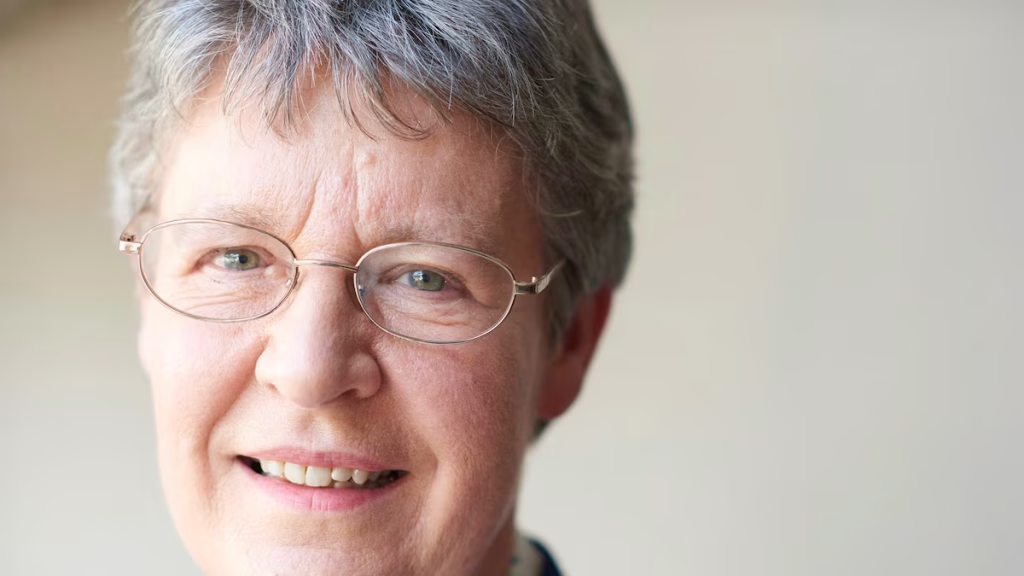
As a PhD student, Bell Burnell built a radio telescope by hand. She then spent months combing through paper printouts before spotting a strange, regular pulse.
Her supervisor initially dismissed that as an interference. It turned out to be the first pulsar ever detected — one of the biggest astronomical surprises of the 20th century. The 1974 Nobel Prize in Physics went to her supervisor, Antony Hewish, and his colleague Martin Ryle. Bell Burnell wasn’t included.
4. Chien-Shiung Wu – The experiment that redefine laws of Physics

Theoretical physicists Tsung-Dao Lee and Chen-Ning Yang proposed that parity — the assumption that nature treats left and right identically — might not always hold. It was Chien-Shiung Wu who designed and ran the ultra-cold cobalt-60 experiment that proved them right.
Under parity conservation, electron emission should have been evenly spread in every direction relative to the nuclear spin. But Wu’s experiment showed otherwise. More electrons came out opposite to the spin direction than in line with it. Lee and Yang won the 1957 Nobel Prize in Physics for the theory. Wu, who provided the evidence, didn’t share it — though she was later awarded the first-ever Wolf Prize in 1978.
5. Nettie Stevens – Discoverer of sex chromosomes

Studying mealworms in 1905, Stevens found that males produce sperm carrying either a large (X) or small (Y) chromosome, while females carry only X — settling a centuries-old debate over what actually determines biological sex.
Wilson published similar conclusions around the same time, but historians note his results were shakier and were revised only after he saw Stevens’s data. Wilson and Thomas Hunt Morgan absorbed most of the credit for decades; Morgan even won a Nobel Prize in 1933 partly built on the idea Stevens had already proven.
Found this article interesting? Subscribe to The Innovators Jam for news, views, and write-ups on innovation, science and research.
Follow us on Instagram @theinnovatorsjam, Youtube @InnovatorsJam, LinkedIn @ The Innovators Jam






We would love to hear from you. Leave your reply here.